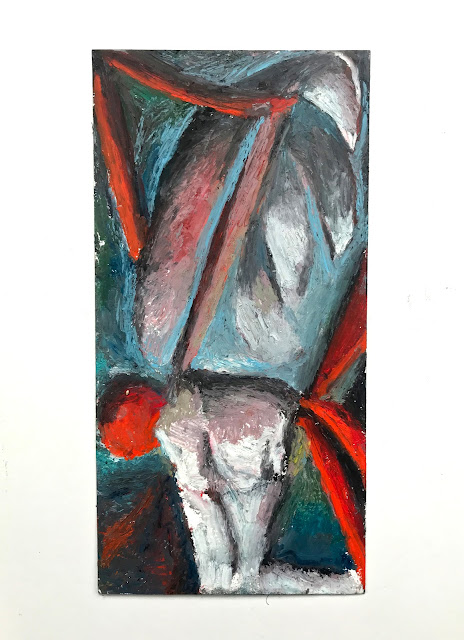
'Rudi Vrba on a curb in Prague with his daughters Zuza and Helena 1958'/
oil on canvas with frame from sections of stretcher bars/ 2020
courtesy of the artist
oil on canvas with frame from sections of stretcher bars/ 2020
courtesy of the artist
Of course you are well known for your art criticism and broadcasting as much as your painting practice, so we’ll start there if that’s okay. You know my feelings about Peter Fuller, as this blog carries a recent essay of mine in which I perhaps look a little nostalgically back at a period of British art writing and criticism that was, for me, extremely inspiring, vibrant and vitally accessible.
You were part of that scene in a big way, and I can’t help feeling that the culture of intellectual oppositions that could be found in the pages of Artscribe International, of which you were an editor, and Modern Painters, say, was much more interesting and stimulating back then, compared to what we read in the pages of Artforum and October journal now for instance. In fact I would argue that Artscribe, and Fuller's Modern Painters, contributed to a period of art criticism that has never been bettered. There was certainly a lot of it being read by artists and art students back then, I think. And also talked about.
How do you feel about all of this -- do you think art writing and criticism has evolved in just as interesting a way as back then? And have you found any shifts in your own approaches to writing criticism over the years?
MC: Well I never thought Peter’s writing was anything other than an embarrassment in those days. I was a student when I first encountered him. He was always in Art Monthly writing this fogey stuff. I got to know him personally in the early ’80s when I was about 28 and had begun editing Artscribe. I invited him to have a go at submitting some articles, which he was happy to do. I accepted a couple and then said this is too boring, no more of that, thanks. He said it was the first time in his life he’d been rejected as a writer. He didn’t mind. I found him great as a person, very funny and human, much more so that most art people. They’re all narcissists, but he was a narcissist while also seeing through himself and his ego and mocking himself. At least behind the scenes. I was in therapy at the time and he’d had it for years because he’d been a gambling addict, and we bonded over that kind of thing. But that didn’t mean I took his art ideas seriously. He assumed I was shallow as an art operator, and I assumed he was an out of touch fantasist. We were frank about our contempt for each other as well as liking each other’s jokes.
Over the years I became more tolerant of some of his themes. Not his turn to political conservatism, however. I agree with him that nature is meaningful, not just a construct, and visual traditions that evolved over hundreds of years are meaningful and not just ideology. I wrote a couple of funny diary pieces for the first issues of Modern Painters, but then he died, and anyway I was very busy in television, so I stopped. After pressuring from the new editor of Modern Painters, Karen Wright, a very dedicated woman, I started doing it again. They were stream of consciousness long chaotic things, where I said what I’d been doing, who I’d met, what ideas occurred to me about meaning and value, and so on, and how mortifying being in the artworld could be -- which the magazine just allowed unedited. I was uninterested in the rest of the mag and took it to be strictly by, and for, old farts. I even despised it more for having my stuff, which is an example of imposter syndrome with which I expect many creative people can identity. But the fact is, that Diary slot for me was incredibly helpful for developing a personal voice. I’m eternally grateful to Karen for it.

Artscribe International, No.55, Dec/Jan 1985-86
First full-colour issue featuring pastel drawing made especially by George Condo,
and interviewed by Collings at his Paris studio.
from the collection of Eric Bainbridge
To return to Artscribe, I worked on it all in all for eight years, beginning in 1979, when I was a year or so out of art school. For the first four years I did various things, from the subscriptions, to the advertising, to managing the office, to becoming editor in 1983. Then after a couple more years, having got some backing from some Americans, I made it into a colour, glossy international mag dedicated to what was new in international art. At the same time, I tried to make it fun and dialectical, with other points of view besides just promotion of fashionable trendies. As well as exciting passing ephemera, art by Schnabel and whoever, there were old-fashioned modernist aesthetes in the mag and Marxist intellectuals. It was a very odd magazine. For a long time, it had few staff. The first designer for example was taken on after I left. A nice guy called Tony, who Neville Brody supplied, when I went to Neville to ask how a magazine should be designed and if he would do it. Until then I laid-out and designed everything, myself -- incredibly inelegantly. And I dictated the content; generating and editing all the articles. A woman who’d escaped from Art Monthly and a young man from Oxford University eventually came in to help part-time. The woman was always horrified by me and found me incredibly brutish, I think. The guy from Oxford was given the job of getting reviews in, but I oversaw them and chucked out reviews I thought might confuse the tone of the mag -- which was a confusing subject because it was just in my head, whatever I thought was interesting moment to moment. It drove Stuart Morgan nuts because he thought you had to speak several languages and have been to university to be an editor, whereas I thought you just had to work very hard and have a sort of massive headlines sense of hypnotically attractive content. Stuart was the most workshy person I ever encountered, but he was genuinely thoughtful and educated. He dithered around on the margins of the mag because it became quite powerful. But he wasn’t really anything to do with it. After a few years I was tipped off my perch, and he slipped in as editor, unable to believe his luck, but then was in fact overwhelmed by all the sheer work involved so he left, and it soon folded after some other editors had a go. They were all perfectly nice, as he was. With him, Artscribe instantly became the same as any other current art magazine, precisely because he wasn’t chaotic and running on mere enthusiasm; he actually had intellectual resources of a formal, disciplined kind, which I’ve always totally lacked.
I went to work at the BBC and was grateful to be out of that other life. But it was only after leaving Artscribe that I started to really write at all myself, as I say with this disorganised streaming sort of voice, which I made up for myself. And in one way or another I’ve always had writing jobs ever since, either TV scripts, books or reviewing. Art magazines today are meaningless because it’s a totally money culture, so only the market decides anything. The market is nothing to do with ideas, only what sells. So, it’s a culturally arid time compared to 40 years ago when art was ruled by ideas. You can find electrifying occasional articles or reviews in Artforum today. Just as you can in the new trashy online art journals. But it’s an accident now. Not the expected thing. Articles now are expected to be verbiage to support promotion and selling. I read very interesting art books all the time, by Benjamin Buchloh and Isabelle Graw for example. But they are refreshing precisely because they’re so unlike the usual run of art articles now. Artforum became junk for wealthy idiots years ago. Pretentious poseurs supplying gibberish to the wealthy. But then, in all that decadence, you’ll find serious thinking now and then. It’s a matter of emphasis. What was always expected from Artforum -- actual thought -- changed around 1980 to a lump of glitzy sludge every month, that allows in an occasional accidental sit-up-and-think moment.
SOTP: You have also been working on a new book on contemporary painting to be published by Thames and Hudson. That’s exciting news, as it seems to me that Phaidon’s ‘Vitamin P’ books have run their course (although the first one was really fantastic, it increasingly looked like a tired format over volumes two and three). However, Tony Godfrey’s ‘Painting Today’, also by Phaidon, has stood the test of time well I think. Can you tell us anything about how you have approached your book, and what we can expect?
MC: It was commissioned 17 years ago by a guy at Thames & Hudson, who years later left to start his own publishing company, and so much time had gone by since my commission he once asked me to write a book for his company on contemporary painting, completely forgetting he’d already commissioned me to write one for Thames & Hudson. It was very hard for various reasons for me ever to get it going, or once going to stick with it and make any sense out of it. The virus lockdown gave me a different perspective I could bring in, and I’m getting on well with it now. It’s objective about ideas out there now, as to what painting is. It examines them. But it’s also subjective and autobiographical, and random. I think it will be a great hit.

Matthew Collings at the Byam Shaw in 1976, aged 21
SOTP: And so to your own practice; first of all, your earlier years. You have always had a painting background as it were, certainly as an undergraduate at Byam Shaw School of Art (here there is a timely and awful connection to our Covid-19 pandemic, as its founder Byam Shaw had died in the 1918-19 Spanish Flu pandemic, having managed to survive World War I in the Artists Rifles.)
What and who were the influences on your early work, and how did this shift or change when you attended Goldsmiths as a postgraduate?
MC: I wanted to fit in with conceptual art, as that was the thing in the ’70s. As soon as I learned it existed, I wanted to do it. But I didn’t have the bravery or stamina, or particular mind set -- I don’t know. In any case at the Byam Shaw I ended up doing what I’d always done, just painting. It took various approaches, but all indebted to Pop. The compartmentalising of space that Pop typically goes in for, and balancing of abstract visual mannerisms with depiction, and the depiction owing something to photos and the mass media. I left the School in 1978 covered in glory for my final year exhibition, but failed to get myself into a postgraduate course, and just drifted around, going more and more neurotic. I write about it in my painting book actually. I went to Goldsmiths 12 years later, after a few years of being at the BBC. The Goldsmiths MA is part-time, so I did it while flying around the world doing BBC films about Kippenberger and Jeff Koons etc. I was desperate to not have my mind dominated by journalism. I loved it at Goldsmiths, but I didn’t come up with anything much, there, in the way of art. However, if I hadn’t gone, I wouldn’t have been able, a few years later, to see the possibilities for paintings in the mosaic work of Emma Biggs -- which I did see, as soon as I started asking her why she put any colour next to another one. I was amazed that someone could have such a confidently assertive idea of colour that was completely practical: this will work, this will not. Goldsmiths gave me an open mind, enough to see that this confidence could be the basis for paintings with no particular author and no particular artistic subjectivity, no individual expression. The painting just will be itself.

Left: Biggs & Collings/ 'The earth is full of violence'/ oil on canvas/ 2020
Right: Emma Biggs/ banner to indicate names of the first UK frontline care workers to die of Covid-19/
wool, towel, sheeting, tape/ in progress, 2020
courtesy of the artists
SOTP: There has been a very interesting tradition of painter-writers, which I think provides something very different and actually more interesting to painters who like to read that sort of stuff- I’m thinking of Patrick Heron for instance, and Mira Schor, who for me has written some of the best things over the years. I love her essay on Bonnard’s Ants, and her accusatory shots at David Salle for instance!
Who are your favourite writers on painting specifically, past or present?
MC: Patrick Heron, Alan Gouk, Clement Greenberg, David Rimanelli’s Instagram and Facebook posts, Isabelle Graw, Meyer Shapiro, Ruskin, Benjamin Buchloh, Merlin Carpenter, Donald Judd, Robert Hughes, Michael Baxendall, TJ Clark from the early ’80s, Rosalind Krauss, Carol Duncan, Carlo Ginzburg- off the top of my head. If I saw something by Diedrich Diederichsen I’d always read it. I have read books on painting by current painters like Carroll Dunham and David Salle, and they’re thrilling because they’re so knowing. But they’re like actors talking about actors. The writing has very glaring gaps. It is cut off from any real ideas and that makes it fatally limited ultimately. But I would always read a review by those two if one pops up in a magazine. The same with painter Amy Sillman who’s very quick witted and articulate.
SOTP: Before I come onto the interesting shift that has happened in your painting practice in very recent times, I’d like to propose to you something that has always struck me about the collaborative paintings you make with Emma Biggs. It kind of brings me back to Fuller again, and his interest in the Romantic and spiritual tradition in British Art, but more importantly his deep interests in the social and political aesthetic of William Morris. I have always regarded the Biggs and Collings’ project as very much following in that Morris tradition -- not simply for the strong design quality you both bring to the paintings, but actually within the deep-seated technical processes you undertake, which seem to me to be really foregrounded in the principles of Morris’s commitment to ideas of the hand-made, and of craft.
How do you feel about this reading?
MC: We respect Morris for being a communitarian, that’s the kind of art meaning we are interested in ourselves with our paintings. Plus, our side-line projects, and Emma’s mosaics -- which are in fact her main project. But she does political banners, and various other things. These are all under the sign of Morris. We are a workshop of two and we respect his workshops of many workers creating objects that are about psychic health. It’s not craft traditions that we identify with but art. We think of him as a very great artist of patterns and nature. We think of our own paintings as landscapes without the landscape. The technical process of our paintings is partly to do with avoiding chaos because there’re two of us, and partly to do with getting the most out of colour.

'Kensal Green 1 pound attic'/ oil on canvas/ 80 x 40cm/ 2020
courtesy of the artist

'Three Floors at Walham Grove'/ oil on canvas/ 72 x 36cm/ 2020
courtesy of the artist

Detail of 'Three Floors at Walham Grove'
SOTP: So these recent paintings of yours are very different from the collaborative paintings, in that they are much more gestural and unstructured by comparison. I was watching that very nice film about the painting and ceramic mosaic installation that you both worked on at Yorkminster Cathedral, called ‘York Five Sisters’. Emma is talking about the attraction of the roundels and geometry in the windows, and we catch a brief glimpse of a collaged pastel design on paper, quite earthy in colour and using repeated circles, which struck me as having a strong connection to your own recent paintings that also use a repeated circular motif.
Is there a link between these new paintings of yours, and the designs and materials you both worked with for the Five Sisters’ work, or I have I just made a coincidental, unconnected leap of the imagination?
MC: Yes. Coincidental in a way. It isn’t a connection I’ve ever had consciously in mind. But I’m interested in structure so there is a connection, I didn’t think about it before. Thank you for making it. I should say our joint paintings are not pre-planned, they’re spontaneous. It’s just that they have a basis of a strict grid, drawn with a hard pencil and a ruler. After that point though we make up everything as we go, working entirely on impulse. The endpoint is when there’s nothing else we can correct. All the relationships are finally supporting a visual theme of order, an order which has multiple, constantly shifting perspectives -- but is always an order. We hope that’s what happens.
With my solo paintings I pile in and try and develop a visual reason for the painting to exist and then I’ll give it a title that refers to my early life, as a sort of reminder that the painting comes out of something I can’t help. But I try and get to a point where there’s an objective visual structure of some kind, a broad rhythm. I’m always over-painting.
SOTP: Yes, so in your most recent solo paintings there is a sort of more narrative type of approach, sometimes involving figures, sometimes landscape, and generally moving in a more depictive (yet gestural) direction. Can you say tell us about the diversity within your current practice, or do you even consider it as diversity?
MC: I do! A chaotic diversity. Considering that some of the abstract paintings also include figurative imagery. If I do enough more work, I will maybe be able to see how it all connects. I like a naive kind of depiction, where rhythms come through without planning. I think of both things, abstracts and landscapes etc, as abstract. But the colour in the descriptive paintings is not daring or imaginative, it’s just naturalistic colour. Whereas the colour in the paintings without depiction is free. But I’m always working to organise in the end, so nothing’s free really.

'Babette Paul Emma painting in trees left to right'/ oil on canvas/ 40 x 70cm/ 2018
courtesy of the artist

Detail of 'Babette Paul Emma painting in trees left to right'

'Your mother the police and the army'/ oil on canvas/ 2020
courtesy of the artist

'Family group sculpture'/ oil on canvas/ 60 x 40cm/ 2020
courtesy of the artist
SOTP: And finally, how has the lockdown situation affected your day-to-day thinking about art, and also your own paintings? It is an unprecedented time and space to be living through for artists just now --it is for everyone -- but do you think it has made you reflect or act on things afresh, or differently?
Once we eventually get to the other side of lockdown, do you have a painting project or exhibition that you want to realise?
MC: No, just the usual: regular shows at Vigo. The lockdown has not been much different for us because we live in an isolated part of the world anyway, no shops, nothing. But we are cut-off from our children and their children, which pains us. This period has been beneficial for my painting book however, and I talk a lot about the politics of the virus in the book, and relate them to current ideas in art.
SOTP: Well it just leaves me to wish you well in all painting and writing, it’s been great to have you visit these lockdown interviews. I’ll be looking out for your next show, and the book!
Matthew Collings studied painting at undergraduate level at Byam Shaw School of Art, from 1974 to 1978, and took his MA at Goldsmiths between 1990 and 1992.
The collaborative paintings and projects with Emma Biggs, called Biggs & Collings, have been ongoing since 2001. They are represented by Vigo Gallery in London.
His books include ‘This Is Modern Art’ (2000), ‘Matt’s Old Masters: Titian, Rubens, Velázquez, Hogarth’ (2003) and ‘This Is Civilisation’ (2008).
Broadcasts include BBC’s ‘Omnibus- Willem de Kooning’ (1995), Channel 4’s ‘This Is Modern Art’ (1998) and ‘Impressionism: Revenge of the Nice’ (2004), and BBC4’s ‘The Rules of Abstraction’ (2014).
He was art critic for The London Evening Standard from 2015 to 2019. He lives and works in Norfolk and France.
Matthew Collings: https://www.instagram.com/matthew.collings/?hl=en
Biggs and Collings: http://emmabiggsandmatthewcollings.net/
Vigo Gallery: http://www.vigogallery.com/artists/7
Biggs and Collings: http://emmabiggsandmatthewcollings.net/
Vigo Gallery: http://www.vigogallery.com/artists/7